

For adults with moderate to severe ulcerative colitis (UC).

†Quarterly analysis of claims data from January 2023–December 2025.



Get ready for your first injection
Once you’ve received your starter doses of ENTYVIO—always administered through intravenous (IV) infusion—you begin your follow-up doses, known as maintenance doses. You and your healthcare provider will discuss which option is right for you. If you’ve chosen to continue receiving ENTYVIO through the ENTYVIO Pen, this page will take you through what the experience is like. A self-administered injection may seem a little intimidating at first, but there are plenty of resources available to help you feel more confident.
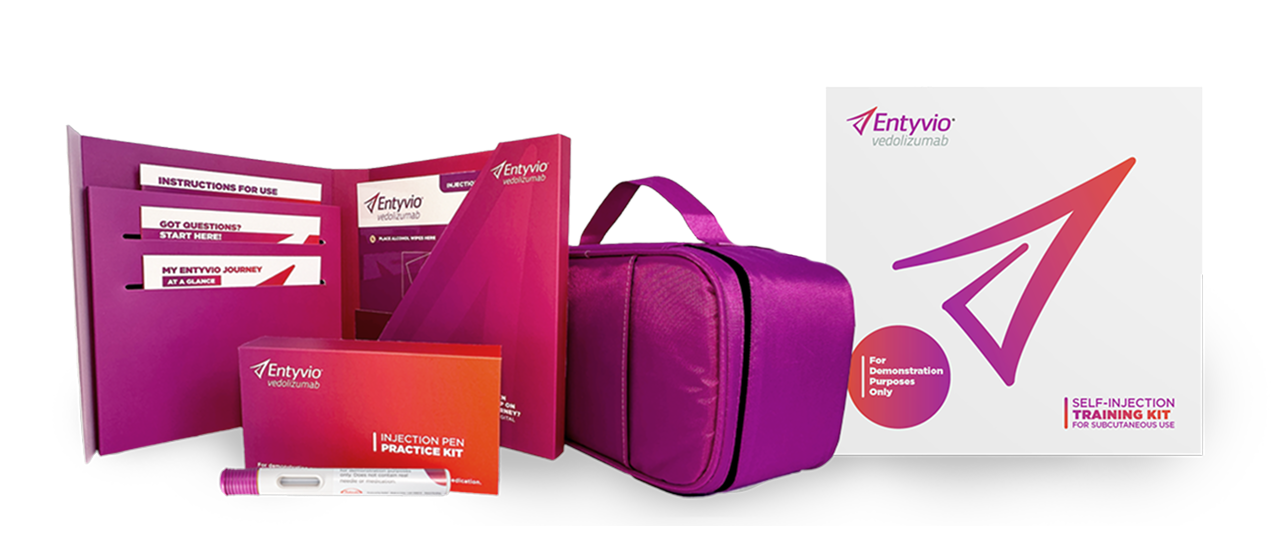
Sign up for EntyvioConnect to talk with a Patient Support Manager and get ongoing personalized support. Your Patient Support Manager can also send you the self-injection training kit, which includes a travel cooler, injection placemat, and even a practice pen so you can get more comfortable with self-injecting.
Call a Patient Support Manager at 1-844-ENTYVIO (1-844-368-9846) to request your self-injection training kit or schedule additional injection training.
How to use the ENTYVIO Pen
Follow the steps in our helpful Instructions for Self-Injection video.
- ENGLISH
- ESPAÑOL
View Instructions for Use
Hello. I'm here today to walk you through the specific steps needed for using the ENTYVIO Pen for subcutaneous use. But remember, your healthcare provider should show you how to use the ENTYVIO Pen before you use it for the first time.
What is ENTYVIO?
ENTYVIO is a prescription medicine used in adults for the treatment of moderate to severe ulcerative colitis (UC) or moderate to severe Crohn’s disease (CD).
SELECTED SAFETY INFORMATION
Do not receive ENTYVIO if you have had an allergic reaction to ENTYVIO or any of its ingredients. ENTYVIO may cause serious side effects, including infusion-related and serious allergic reactions, while receiving ENTYVIO or several hours after treatment. ENTYVIO may increase your risk of serious infections. If your healthcare provider feels that you are at risk for tuberculosis (TB), you may be treated with medicine for TB before you begin treatment with ENTYVIO. Although unlikely, progressive multifocal leukoencephalopathy (PML), a rare, serious brain infection caused by a virus, cannot be ruled out. Liver problems can occur with ENTYVIO.
Please see additional Important Safety Information at the end of this video.
We’ll be visiting Sam's house, and Sam will be demonstrating the process while I lead you through the video. During this video, I'll cover these steps in 3 chapters, beginning with getting your supplies ready, then preparing to inject ENTYVIO, and lastly, injecting ENTYVIO. Okay. Let's get started!
So...what is the ENTYVIO Pen? It's a pre-filled pen designed to deliver an accurate, pre-measured dose of medication under the skin. Now let's get into the details on how to use the pen. Start by getting your supplies ready. The first thing you'll want to do is remove the ENTYVIO Pen box from its storage in your refrigerator.
ENTYVIO needs to be stored in a refrigerator—but if you're traveling, ENTYVIO can be kept safely in its box at room temperature for up to 7 days. Do not use the pen if it is past its expiration date.
After removing the pen from the box in the fridge, wait 30 minutes and let the pen come to room temperature. You may want to set a timer or use your phone to set a 30-minute reminder. Also, don't try to warm the pen quickly or let the pen sit in direct sunlight. And don't take the pen out of its tray until you're ready to inject.
You should gather these supplies on a clean, flat surface before your injection. You'll want some alcohol pads, a cotton ball or gauze, and you'll also want a sharps container on hand to put your pen in after you've finished your injection.
Now you can get ready to inject ENTYVIO. First, you'll need to thoroughly wash your hands with soap and water. Now, take the pen from the box and remember, don't use the pen if any of the seals on the box are broken or if the expiration date on the box has passed.
Next, peel off the paper on the tray and then remove the pen. Don't shake the pen or remove the purple cap from the pen. Now you'll want to inspect the pen. The main things you're checking for here are the expiration date and the medicine in the pen window. The medicine should be colorless to pale yellow, and it is normal to see air bubbles. Don't use the pen if the expiration date on the pen has passed or if the medicine is cloudy or has particles floating in it. And you don't want to use the pen if any part of it is damaged.
Now it's time to choose an injection site. If you're self-injecting, you can choose the front of your thigh or a place on your stomach. Just don't inject too close to your belly button. If you have a caregiver, they can help by injecting into the back of your upper arm.
Be sure not to inject in the same spot of your last dose and avoid injecting into moles, scars, bruises, or skin that's tender, hard, red, or damaged. It's now time to clean the injection site with the alcohol pad. Don’t touch or blow on the cleaned injection site before you inject. Be sure to let your skin dry before moving to the next step.
Let's review how to inject ENTYVIO. Note the purple cap. You want to pull it straight off and dispose of it in a sharps container right away. The needle is inside the yellow needle shield, right there, under the purple cap. Remember, do not put or press your thumb, fingers, or hand over the yellow needle shield. And don't put the purple cap back on because this could accidentally start the injection.
Now you should hold the pen so you can see the viewing window. Then place the yellow end of the pen flat on your skin at 90 degrees to the injection site. And be sure not to push down on the pen until you're ready to inject.
Now you're ready to start injecting ENTYVIO. Push the pen straight down and hold for at least 10 seconds. You may hear a first click when the injection starts. You may also hear a second click. This is not the end of the injection. Continue holding the pen with constant pressure and watch the window fill with purple.
The injection is now complete. However, when you lift the pen from the skin, you will see a small amount of gray in the viewing window, but this is normal. If the viewing window did not fill with purple, you may not have received your full dose. If this happens, call your pharmacy or healthcare provider.
The yellow needle shield will drop down and lock over the needle. When you lift the pen, if the window has not turned purple, or it looks like medicine is still coming out of the pen, you may not have received a full dose. If this happens, call your pharmacy or healthcare provider. You may also see a small amount of blood at the injection site. If so, press on your skin with a cotton ball or gauze.
When it's time to throw away your ENTYVIO Pen, make sure you use an FDA-cleared sharps disposal container right after use. Do not recycle or toss the pen in your household trash. Throw the remaining supplies in your household trash or sharps disposal container.
Most specialty pharmacies have sharps programs that can help you access an FDA-cleared container, but you can also make your own safe disposal container. For instance, an empty laundry detergent bottle can be used. Just be sure to label it appropriately. Do not dispose of your used sharps disposal container in your household trash unless your community guidelines permit this.
We've covered all of the steps, so you should be all set with instructions on how to use the ENTYVIO Pen for subcutaneous use. And remember—you can always watch this video again if you need a quick refresher. And if you'd like to find out more about resources and assistance that ENTYVIO offers to help manage your treatment, including in-home injection training, visit ENTYVIO.com/EntyvioConnect for more information.
IMPORTANT SAFETY INFORMATION
- Do not receive ENTYVIO® if you have had an allergic reaction to ENTYVIO or any of its ingredients.
- ENTYVIO may cause serious side effects, including:
- Infusion-related and serious allergic reactions can happen while you are receiving ENTYVIO or several hours after treatment. You may need treatment if you have an allergic reaction. Tell your healthcare provider or get immediate medical help if you get any of these symptoms during or after an infusion of ENTYVIO: rash, itching, swelling of your lips, tongue, throat or face, shortness of breath or trouble breathing, wheezing, dizziness, feeling hot, or palpitations (feel like your heart is racing).
- Infections. ENTYVIO may increase your risk of getting a serious infection. Before and during treatment with ENTYVIO, tell your healthcare provider if you think you have an infection or symptoms of an infection, such as fever, chills, muscle aches, cough, shortness of breath, runny nose, sore throat, red or painful skin or sores on your body, tiredness, or pain during urination. If your healthcare provider feels that you are at risk for tuberculosis (TB), you may be treated with medicine for TB before you begin treatment with ENTYVIO.
- Progressive Multifocal Leukoencephalopathy (PML). People with weakened immune systems can get progressive multifocal leukoencephalopathy (PML) (a rare, serious brain infection caused by a virus). Although unlikely while receiving ENTYVIO, a risk of PML cannot be ruled out. PML can result in death or severe disability. There is no known treatment, prevention, or cure for PML. Tell your healthcare provider right away if you have any of the following symptoms: confusion or problems thinking, loss of balance, change in the way you walk or talk, decreased strength or weakness on one side of the body, blurred vision, or loss of vision.
- Liver problems can happen in people who receive ENTYVIO. Tell your healthcare provider right away if you have any of the following symptoms: tiredness, loss of appetite, pain on the right side of your abdomen, dark urine, or yellowing of the skin and eyes (jaundice).
- The most common side effects of ENTYVIO include: common cold, headache, joint pain, nausea, fever, infections of the nose and throat, tiredness, cough, bronchitis, flu, back pain, rash, itching, sinus infection, throat pain, pain in extremities, and with injections under the skin: pain, swelling, itching, hives, bruising, rash, or redness at the injection site. These are not all the possible side effects of ENTYVIO. Call your healthcare provider for medical advice about side effects.
- Before receiving ENTYVIO, tell your healthcare provider about all of your medical conditions, including if you: have or think you may have an infection or have infections that keep coming back; have liver problems; have TB or have been in close contact with someone with TB; have recently received or are scheduled to receive a vaccine; or if you are pregnant, breastfeeding, plan to become pregnant, or plan to breastfeed.
- Tell your healthcare provider about all the medicines you take, especially if you take or have recently taken Tysabri (natalizumab), Tyruko (natalizumab-sztn), a Tumor Necrosis Factor (TNF) blocker medicine, a medicine that weakens your immune system (immunosuppressant), or corticosteroid medicine.
Please see full Prescribing Information, including the Medication Guide, for ENTYVIO at ENTYVIO.com/PI and talk with your healthcare provider.
ENTYVIO is available for:
- intravenous (IV) infusion: 300 mg vedolizumab.
- subcutaneous (SC) injection: 108 mg vedolizumab.
You are encouraged to report negative side effects of prescription drugs to the FDA.
Visit www.fda.gov/medwatch or call 1-800-FDA-1088.
What is ENTYVIO (vedolizumab)?
ENTYVIO is a prescription medicine used in adults for the treatment of:
- moderately to severely active ulcerative colitis (UC).
- moderately to severely active Crohn’s disease (CD).
It is not known if ENTYVIO is safe and effective in children under 18 years of age.
Haz clic aquí para ver la guía de Medicación y
las Instrucciones de Uso
Este video lo guiará por los pasos específicos necesarios para usar la pluma de ENTYVIO para uso subcutáneo.
Pero recuerde, su proveedor de atención médica debe mostrarle cómo usar la pluma de ENTYVIO antes de usarla por primera vez.
¿Qué es ENTYVIO?
ENTYVIO es un medicamento recetado que se usa en adultos para el tratamiento de la colitis ulcerosa (ulcerative colitis, UC) de moderada a grave o la enfermedad de Crohn (Crohn’s disease, CD) de moderada a grave.
INFORMACIÓN DE SEGURIDAD SELECCIONADA:
No reciba ENTYVIO si ha tenido una reacción alérgica a ENTYVIO o a cualquiera de sus ingredientes. ENTYVIO puede causar efectos secundarios serios, incluidas reacciones alérgicas serias y relacionadas con la infusión, mientras está recibiendo ENTYVIO, o varias horas después del tratamiento. ENTYVIO puede incrementar su riesgo de contraer infecciones serias. Si su proveedor de atención médica cree que corre riesgo de tener tuberculosis (TB), es posible que se lo trate con medicamentos para la TB antes de que empiece el tratamiento con ENTYVIO. Aunque es improbable, no puede descartarse la leucoencefalopatía multifocal progresiva (progressive multifocal leukoencephalopathy, PML), una infección del cerebro rara y seria causada por un virus. Con ENTYVIO pueden producirse problemas hepáticos.
Consulte la Información importante de seguridad adicional en este video.
Desde su casa, Sam nos mostrará el proceso.
Durante este video, trataremos estos pasos en tres capítulos, comenzando por la preparación de los suministros, la preparación para la inyección de ENTYVIO y, por último, la inyección de ENTYVIO.
¡Empecemos!
Entonces... ¿Qué es la pluma de ENTYVIO?
Es una pluma precargada diseñada para administrar una dosis exacta y premedida de medicamento bajo la piel.
Ahora veamos los detalles sobre cómo usar la pluma.
Comience con la preparación de los suministros.
Lo primero que debe hacer es sacar la caja de la pluma de ENTYVIO del lugar donde la guarda en el refrigerador.
ENTYVIO debe conservarse en un refrigerador, pero si viaja, ENTYVIO puede conservarse de forma segura en su caja a temperatura ambiente durante un máximo de 7 días.
No utilice la pluma si ha pasado la fecha de caducidad.
Después de sacar la pluma de la caja del refrigerador, espere 30 minutos y deje que la pluma alcance la temperatura ambiente.
Es posible que desee configurar un temporizador o usar su teléfono para establecer un recordatorio de 30 minutos.
Además, no intente calentar la pluma rápidamente ni deje que la pluma quede expuesta a la luz solar directa.
Y no saque la pluma de su bandeja hasta que esté listo para inyectar.
Debe reunir estos suministros en una superficie limpia y plana antes de la inyección.
Necesitará unas almohadillas con alcohol, una bolita de algodón o una gasa, y también un recipiente para objetos cortopunzantes a mano para colocar la pluma después de haber terminado la inyección.
Ahora puede prepararse para inyectar ENTYVIO.
Primero, tendrá que lavarse bien las manos con agua y jabón.
A continuación, saque la pluma de la caja y recuerde: no utilice la pluma si alguno de los sellos de la caja está roto o si la fecha de caducidad que figura en la caja es posterior a la fecha actual.
Luego, despegue el papel de la bandeja y, a continuación, retire la pluma.
No agite la pluma ni retire la tapa morada de la pluma.
Ahora deberá inspeccionar la pluma.
Lo más importante que debe comprobar aquí es la fecha de caducidad y el medicamento en la ventana de visualización de la pluma.
El medicamento debe ser incoloro o de color amarillo pálido, y es normal que contenga burbujas de aire.
No utilice la pluma si la fecha de caducidad de la pluma ha pasado o si el medicamento está turbio o tiene partículas flotando en él.
Y no debe utilizar la pluma si alguna de sus partes está dañada.
Ahora es el momento de elegir un lugar de inyección.
Si se autoadministra la inyección, puede elegir la parte frontal del muslo o una zona del estómago.
Simplemente no se ponga la inyección demasiado cerca del ombligo.
Si cuenta con un cuidador, puede ayudarle aplicando la inyección en la parte posterior de la parte superior del brazo.
Procure no inyectar en el mismo lugar que la última dosis y evite hacerlo en lunares, cicatrices, moretones o en piel sensible, dura, enrojecida o dañada.
Ha llegado el momento de limpiar el lugar de inyección con la almohadilla con alcohol.
No toque ni sople el lugar de inyección limpio antes de la inyección.
Asegúrese de dejar que la piel se seque antes de continuar con el paso siguiente.
Revisemos cómo inyectar ENTYVIO.
Observe la tapa morada.
Debe tirar de esta en línea recta y desecharla en un recipiente para objetos punzocortantes inmediatamente.
La aguja está dentro del protector amarillo de la aguja, justo allí, debajo de la tapa morada.
Recuerde, no coloque ni presione el pulgar, los dedos ni la mano sobre el protector amarillo de la aguja.
Y no vuelva a poner la tapa morada porque esto podría iniciar accidentalmente la inyección.
Ahora, sujete la pluma para que pueda ver la ventana de visualización.
Luego, coloque el extremo amarillo de la pluma sobre la piel a 90 grados con respecto al lugar de inyección.
Y asegúrese de no empujar la pluma hacia abajo hasta que esté listo para inyectar.
Ahora está listo para empezar a inyectar ENTYVIO.
Empuje la pluma hacia abajo en línea recta y manténgala pulsada durante al menos 10 segundos.
Es posible que oiga un primer clic cuando comience la inyección.
Es posible que también oiga un segundo clic.
Este no es el final de la inyección.
Continúe sujetando la pluma con presión constante y observe cómo la ventana de visualización se vuelve morada.
La inyección ha finalizado.
Sin embargo, cuando levante la pluma de la piel, verá un ligero tono gris en la ventana de visualización, pero esto es normal.
Si la ventana de visualización no se ha vuelto morada, es posible que no haya recibido su dosis completa.
Si esto sucede, llame a su farmacia o proveedor de atención médica.
El protector amarillo de la aguja se caerá y se bloqueará sobre la aguja.
Cuando levante la pluma, si la ventana de visualización no se ha vuelto morada o parece que el medicamento sigue saliendo de la pluma, es posible que no haya recibido una dosis completa.
Si esto sucede, llame a su farmacia o proveedor de atención médica.
Es posible que también vea una pequeña cantidad de sangre en el lugar de inyección.
Si es así, presione la piel con una bolita de algodón o gasa.
A la hora de desechar la pluma de ENTYVIO, asegúrese de utilizar un recipiente para desechar objetos punzocortantes aprobado por la Administración de Alimentos y Medicamentos (Food and Drug Administration, FDA) inmediatamente después de usarla.
No recicle ni deseche la pluma en la basura doméstica.
Deseche los suministros restantes en la basura doméstica o en el recipiente para desechar objetos cortopunzantes.
La mayoría de las farmacias especializadas tienen programas para objetos cortopunzantes que pueden ayudarlo a acceder a un contenedor aprobado por la FDA, pero también puede fabricar su propio recipiente para la eliminación segura de objetos.
Por ejemplo, se puede utilizar una botella vacía de detergente para la ropa.
Simplemente asegúrese de etiquetarla de forma adecuada.
No deseche su recipiente para desechar objetos punzocortantes usados en la basura doméstica, a menos que las pautas de su comunidad lo permitan.
Estos son todos los pasos, así que ya debería tener todas las instrucciones necesarias para utilizar la pluma ENTYVIO para uso subcutáneo.
Y recuerde: siempre puede ver este video de nuevo si necesita un repaso rápido.
Si desea obtener más información sobre los recursos y la asistencia que ofrece ENTYVIO para ayudarlo a gestionar su tratamiento, incluida la capacitación sobre inyecciones en el hogar, visite ENTYVIO.com/entyvioconnect para obtener más información.
INFORMACIÓN IMPORTANTE SOBRE SEGURIDAD:
- No reciba ENTYVIO® si ha tenido una reacción alérgica a ENTYVIO o a cualquiera de sus ingredientes.
- ENTYVIO puede causar efectos secundarios serios, incluidos los siguientes:
- Pueden ocurrir reacciones alérgicas serias y relacionadas con la infusión mientras está recibiendo ENTYVIO, o varias horas después del tratamiento. Es posible que necesite tratamiento si tiene una reacción alérgica. Informe a su proveedor de atención médica u obtenga ayuda médica inmediata si presenta cualquiera de estos síntomas durante o después de una infusión de ENTYVIO: erupción, comezón, inflamación de los labios, la lengua, la garganta o la cara, falta de aliento o dificultad para respirar, sibilancias, mareos, sensación de calor o palpitaciones (sensación de latidos acelerados del corazón).
- Infecciones. ENTYVIO puede incrementar su riesgo de contraer una infección seria. Antes y durante el tratamiento con ENTYVIO, informe a su proveedor de atención médica si cree que tiene una infección o síntomas de infección, como fiebre, escalofríos, dolores musculares, tos, falta de aliento, goteo nasal, dolor de garganta, enrojecimiento o dolor en la piel o ampollas en el cuerpo, cansancio o dolor al orinar. Si su proveedor de atención médica cree que corre riesgo de tener tuberculosis (TB), es posible que se lo trate con medicamentos para la TB antes de que empiece el tratamiento con ENTYVIO.
- Leucoencefalopatía multifocal progresiva (progressive multifocal leukoencephalopathy, PML). Las personas con sistemas inmunitarios debilitados pueden contraer leucoencefalopatía multifocal progresiva (PML) (una infección del cerebro rara y seria causada por un virus). Aunque es improbable que suceda mientras recibe ENTYVIO, no se puede descartar un riesgo de PML. La PML puede provocar la muerte o discapacidad severa. No existe cura, prevención ni tratamiento conocidos para la PML. Informe inmediatamente a su proveedor de atención médica si tiene alguno de los siguientes síntomas: confusión o problemas para pensar, pérdida del equilibrio, cambio en la forma en la que camina o habla, disminución de la fuerza o debilidad en un costado del cuerpo, visión borrosa o pérdida de la visión.
- Pueden producirse problemas hepáticos en personas que reciben ENTYVIO. Informe inmediatamente a su proveedor de atención médica si tiene alguno de los siguientes síntomas: cansancio, pérdida del apetito, dolor en el costado derecho del abdomen, orina oscura o coloración amarillenta de la piel y los ojos (ictericia).
- Los efectos secundarios más frecuentes de ENTYVIO incluyen: resfriado común, dolor de cabeza, dolor de las articulaciones, náuseas, fiebre, infecciones de nariz y garganta, cansancio, tos, bronquitis, gripe, dolor de espalda, erupción, comezón, infección sinusal, dolor de garganta, dolor en las extremidades; y con la inyección debajo la piel: dolor, hinchazón, comezón, urticaria, moretones, erupción o enrojecimiento en el lugar de inyección. Estos no son todos los posibles efectos secundarios de ENTYVIO. Llame a su proveedor de atención médica para obtener asesoramiento médico sobre los efectos secundarios.
- Antes de recibir ENTYVIO, informe a su proveedor de atención médica sobre todas sus enfermedades, incluso si: tiene o piensa que podría tener una infección o tiene infecciones que regresan una y otra vez; tiene problemas hepáticos; tiene TB o ha tenido contacto cercano con alguien con TB; recibió recientemente o tiene programado recibir una vacuna; o si está embarazada, amamantando, planea quedar embarazada, o planea amamantar.
- Informe a su proveedor de atención médica sobre todos los medicamentos que toma, especialmente si toma o tomó recientemente Tysabri (natalizumab), un medicamento que bloquea el factor de necrosis tumoral (tumor necrosis factor, TNF), un medicamento que debilita el sistema inmunitario (inmunosupresor) o un medicamento corticoesteroide.
Consulte la Información de prescripción completa adjunta, incluida la Guía del medicamento, de ENTYVIO en ENTYVIO.com/PI y hable con su proveedor de atención médica.
ENTYVIO está disponible como:
- infusión intravenosa (i.v.): 300 mg de vedolizumab
- inyección subcutánea (SC): 108 mg de vedolizumab
Se le recomienda que informe los efectos secundarios negativos de los medicamentos recetados a la Administración de Alimentos y Medicamentos (Food and Drug Administration, FDA).
Visite www.fda.gov/medwatch o llame al 1-800-FDA-1088.
¿Qué es ENTYVIO® (vedolizumab)?
ENTYVIO es un medicamento recetado que se usa en adultos para el tratamiento de:
- Colitis Ulcerosa (ulcerative colitis, UC) activa de moderada a grave.
- Enfermedad de Crohn (Crohn’s disease, CD) activa de moderada a grave.
Se desconoce si ENTYVIO es seguro y eficaz en menores de 18 años.
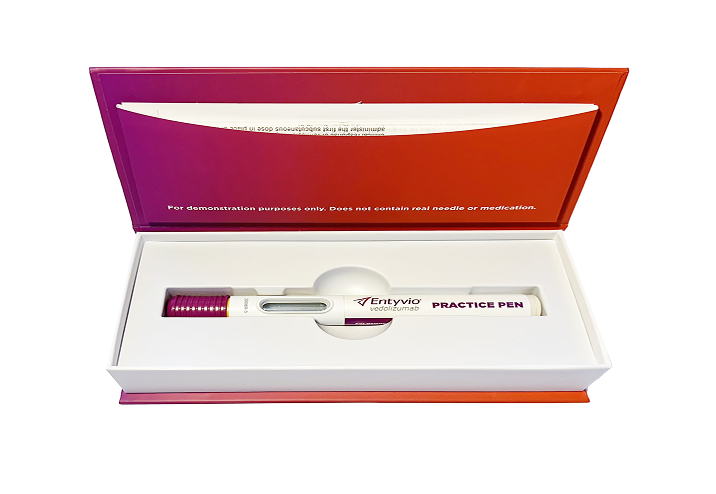
Injection Training Kit
If you haven’t already, sign up for EntyvioConnect and ask your Nurse Educator to send you the self-injection training kit—which includes a travel cooler, injection placemat, and even a practice pen so you can feel more comfortable with self-injecting.
Request your self-injection training kit by calling 1-844-ENTYVIO (1-844-368-9846)
What are maintenance doses like?
The ENTYVIO Pen supports your UC or Crohn's therapy at home or on the go. A specialty pharmacy will reach out to you regarding coordination and delivery of the ENTYVIO Pen. Then, after your starting IV doses, your maintenance therapy begins.
Throughout treatment, it’s important to keep having open and honest conversations with your healthcare provider. If you have any injection site reactions, be sure to reach out to them.
How often do you inject ENTYVIO?
Maintenance schedule
Every 2 weeks
With the ENTYVIO Pen you will inject ENTYVIO every 2 weeks or 26 times a year.
“I chose the ENTYVIO Pen because it fit my lifestyle.”
— Shivani, real ENTYVIO patient
Patients can switch to the ENTYVIO Pen after at least 2 IV doses.


Want to learn more about ENTYVIO and how it works?
Enter your email below for more information.